
A place to begin
Begin with a small set of cards or one sheet of paper. Agree on a simple rule, play a round, then change it together.
You can build an afternoon activity from ordinary paper and pencils. The fun is partly in making the game, partly in deciding the rules, and partly in discovering that everyone interprets those rules a little differently.
These are ideas for adults to adapt for their family. Choose materials and a level of difficulty appropriate for each child. Adults should handle cutting when needed, and help children use tools according to their instructions. The activities are not assessments of attention or development.
Make a tiny matching game
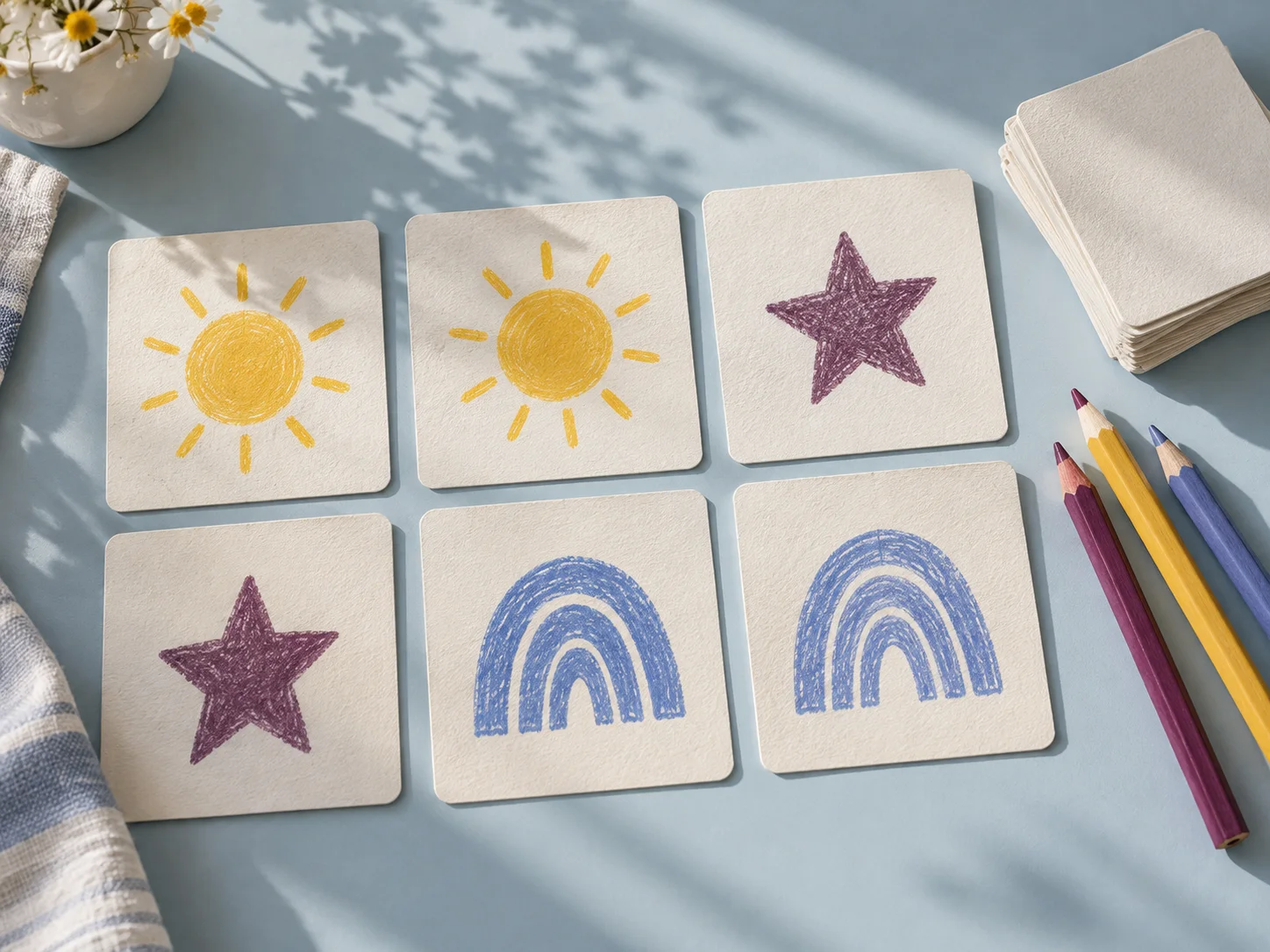
Start with six large, equally sized pieces of opaque paper or card. Draw three pairs of simple pictures: two suns, two stars, and two arches, for example. Make the backs look the same so the picture is not visible when a card is turned over.
Lay the cards face down in two rows. Take turns turning over two cards. If the pictures match, keep the pair. If they do not, turn them back over before the next turn.
For an easier version, leave the cards face up and find the pairs together. If your family wants a longer game, add one new pair at a time. Stop when the people playing have had enough, rather than aiming for a particular score.
Turn a line into a picture
One person draws a line or a simple shape on a sheet of paper. The next person adds to it to make something recognizable—or something entirely imaginary.
Pass the paper around again and let each person add one detail. A loop might become a balloon, then a strange flying machine, then a character in a story.
Use separate sheets if sharing one page becomes frustrating. You can still start with the same shape and compare the different pictures at the end.
Build a story one picture at a time
Draw a few simple pictures on separate large cards: a house, a hat, a cloud, a boat. Place them where everyone can see them.
Choose one card to begin a story. The next person chooses another picture and adds a sentence. Continue until you reach an ending you like, or until the story becomes too silly to keep a straight face.
An adult can write down a favorite line. A child who prefers drawing can add the next picture instead of speaking. There is no need for every person to contribute in the same way.
Let the rules change
After the first round, ask which part people would like to keep. Perhaps the matching game becomes a picture-sorting game, or the story cards become a small handmade book.
The materials are a starting point. You can make the session shorter, use fewer pieces, or play cooperatively whenever that works better for your family.
Browse more family play ideas, or find something for your own quiet time.
Set up one game at a time
Put out paper and pencils first, then choose one game together. Adults can prepare the large cards in advance if cutting would interrupt the activity. Opaque card is useful for the matching game because a visible picture on the back gives away the answer.
Keep the first round small enough to explain in a sentence. For example: “We each turn over two cards and look for the same picture.” Agree beforehand whether a match earns another turn; either rule is fine if everyone knows it.
Choose tools and materials suitable for the children present, and supervise their use. The suggested games are not age assessments: reading, drawing, and comfort with turn-taking differ between children.
Adapt the game without calling it easier or harder
For a child who prefers to watch first, let an adult play a demonstration round. Someone who does not want to speak can point to the next story card or draw an addition. Someone who finds matching frustrating can keep all the cards visible and sort pictures together.
In the shared drawing game, offer a separate page when a child wants control over their own picture. The pages can still start from the same shape. Comparing different ideas does not require voting for a winner.
A natural stopping point might be one completed picture or one short story. Save the cards in an envelope if people want to return to them. There is no need to keep playing just because more materials remain on the table.
Words and ideas from InklessEdit. Read our editorial approach.
← Back to the journal